
Your assessment data is analyzed, your intervention groups are set, and you have a short block of time each day to close some serious reading gaps. So what exactly should happen during that time? By now you are well into your reading interventions, and planning those lessons is the one thing most schools never train teachers to do.
When planning your reading intervention lessons, it is important to follow a clear set of steps. Remember, lesson plans do not have to be detailed or lengthy because we know time is of the essence. They should, however, be specific to targeted skill deficits.
Start With Your Reading Assessment Data
After you have analyzed the reading assessment data, the first step is to map out the standards and skills you will cover for the first 6–8 weeks.
The 6 Steps Every Reading Intervention Lesson Plan Should Include
In this blog, I will discuss the steps each small group lesson plan should entail. Note: I give time suggestions, but they can be adjusted depending on how much time you have for your intervention groups.
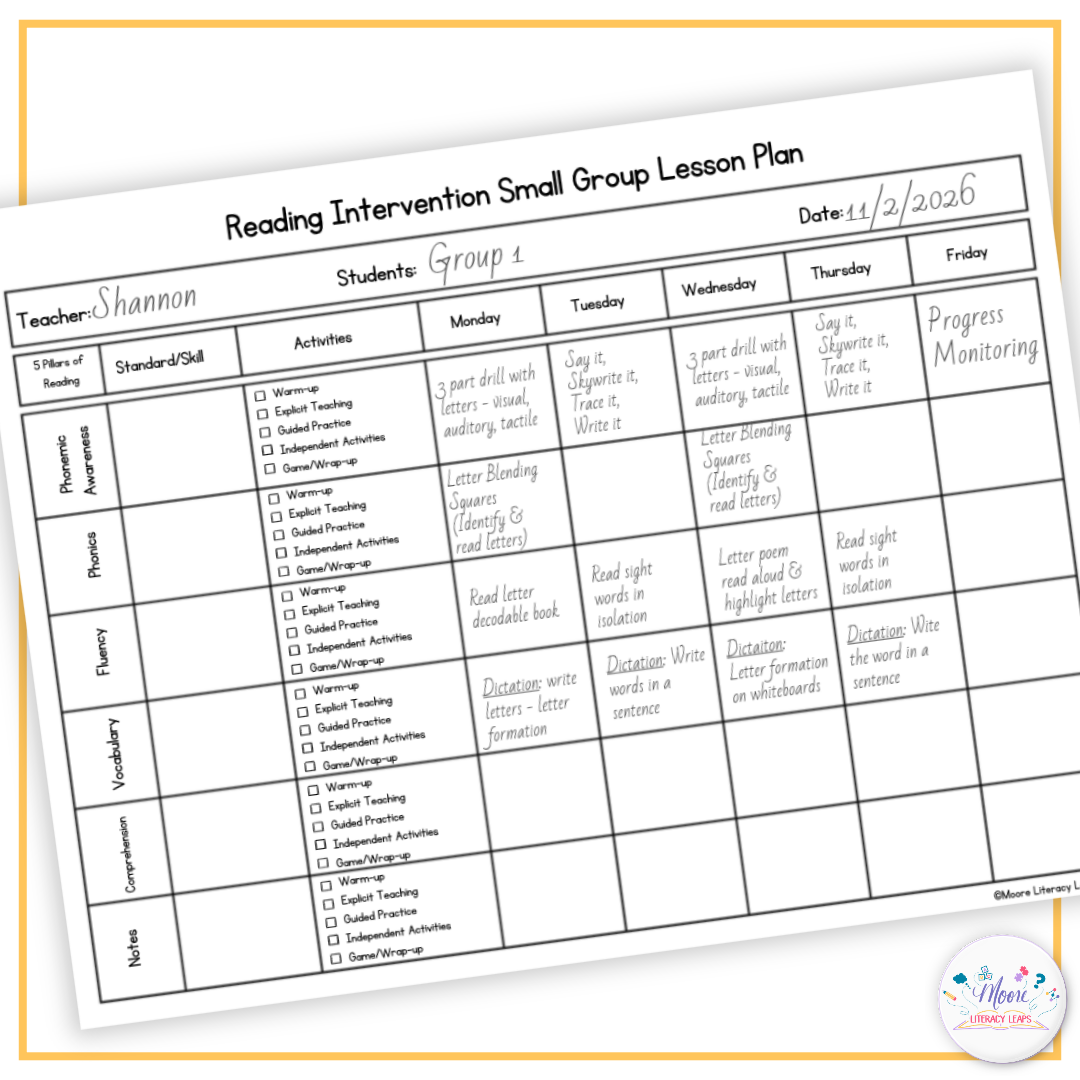
Step 1: Phonemic Awareness Warm-Up/Review (3 Minutes Max)
You want to start your lessons with some type of phonemic awareness warm-up. It should be a review of the skills that have been previously taught. These activities should be no more than 3 minutes, and they should be sound activities only. This can be done with lower and upper elementary students.
Ex. "Can you guess my word? /c/ /a/ /t/" OR "What are the sounds you hear in the word cat?"
An upper elementary activity could be a 3-part drill with Greek and Latin roots.
Ex. 3-part drill: Show the word card with the Greek root "tele."
Show the card and have the students say the root.
Read the root on the card, "tele," and have students spell the root.
Tactile/Kinesthetic: Say the root and have students write it or build it on dry-erase boards.
Step 2: Introduce the New Skill – I Do (5 Minutes)
Now, when I say introduce a new skill, that doesn't mean teach a completely new skill to your group. It means introduce the skill you are going to teach to the group. Remember, reading interventions are review, and ALL reading skills should be introduced whole group in Tier 1 prior to the students working with you.
Ex. "Today we are going to work on reading words that have the short a sound."
This is where you introduce the short a words you intend to explicitly teach. Be sure to have at least 5–10 words that students can work with. This is also where you want to explicitly teach segmenting and blending. Elkonin sound boxes would be a great multisensory activity to do at this point.
For upper elementary students, you could have them segment and blend word parts. Ex., unhappy or dependable. Students will place each word part in the sound boxes, and then you can discuss the vowel sounds and syllable types to help students decode the unknown word.
Step 3: Guided Practice – We Do (5 Minutes)
This is the part of the lesson that you want to do right alongside your students. Think of yourself as the "guide on the side" during this time. You want to guide them, but you want to let them have productive struggle and self-correct on their own. During this phase of the lesson plan, you will give corrective feedback as needed.
Ex. Students will read words with short a CVC patterns. You could give students a list of words to read, making sure they remember to use decoding skills if needed. Upper elementary students can read words that contain the root "tele."
Step 4: Independent Practice – You Do
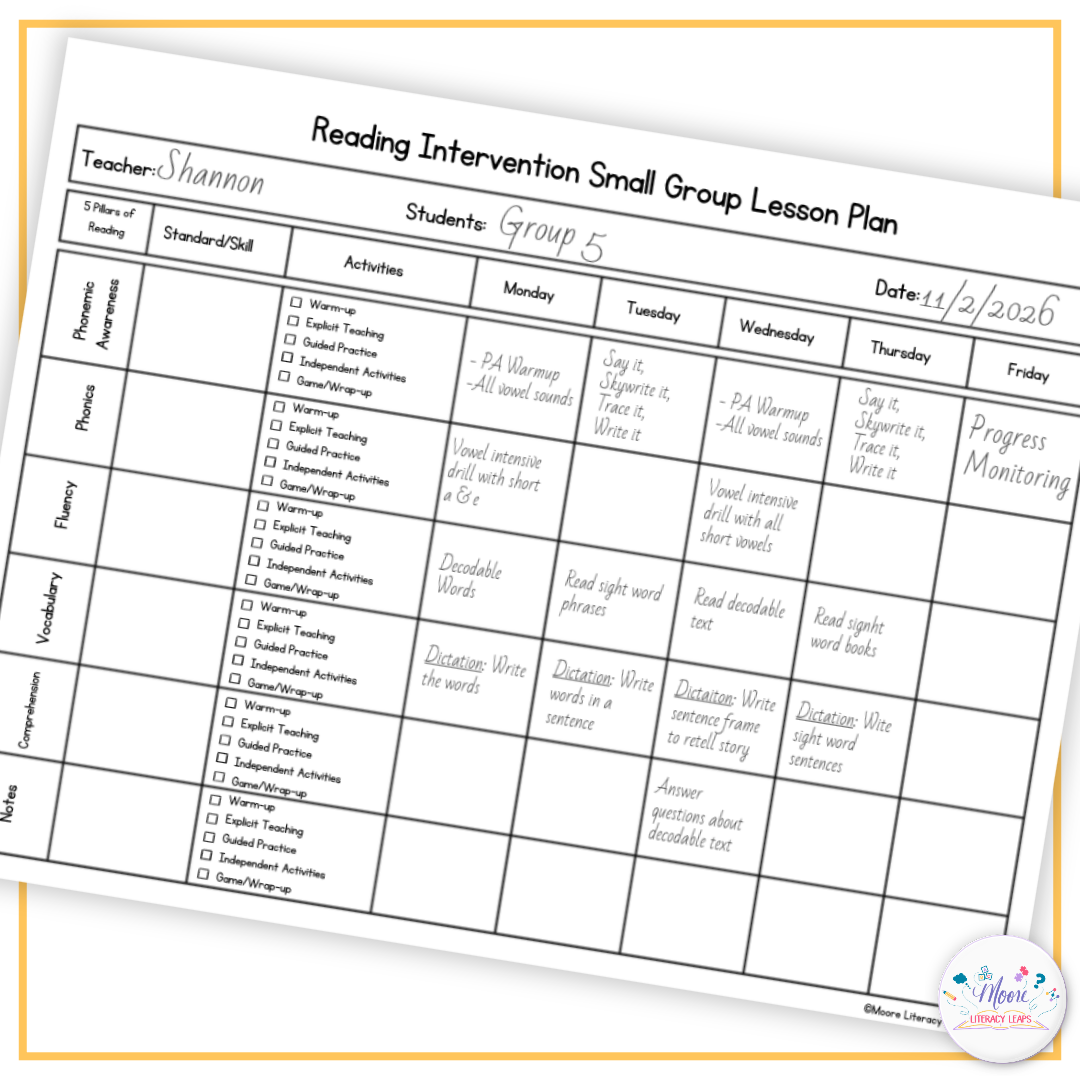
Now allow the majority of your time for independent practice. This can be a reading or writing activity that students can do independently. Students can practice by reading a blending fluency line activity, OR upper elementary students can read a Greek and Latin root word fluency activity.
Step 5: Reading Connected Text
Always incorporate reading a connected text. This is important because we don't want to put all the focus of the lesson on reading words in isolation. We want students to be able to transfer that learning to reading a text with the specific phonics skill words.
Ex. Have students read a decodable text with short a CVC words, OR upper elementary students can read a text (short paragraph or short story) with the specified root words.
Step 6: Dictation
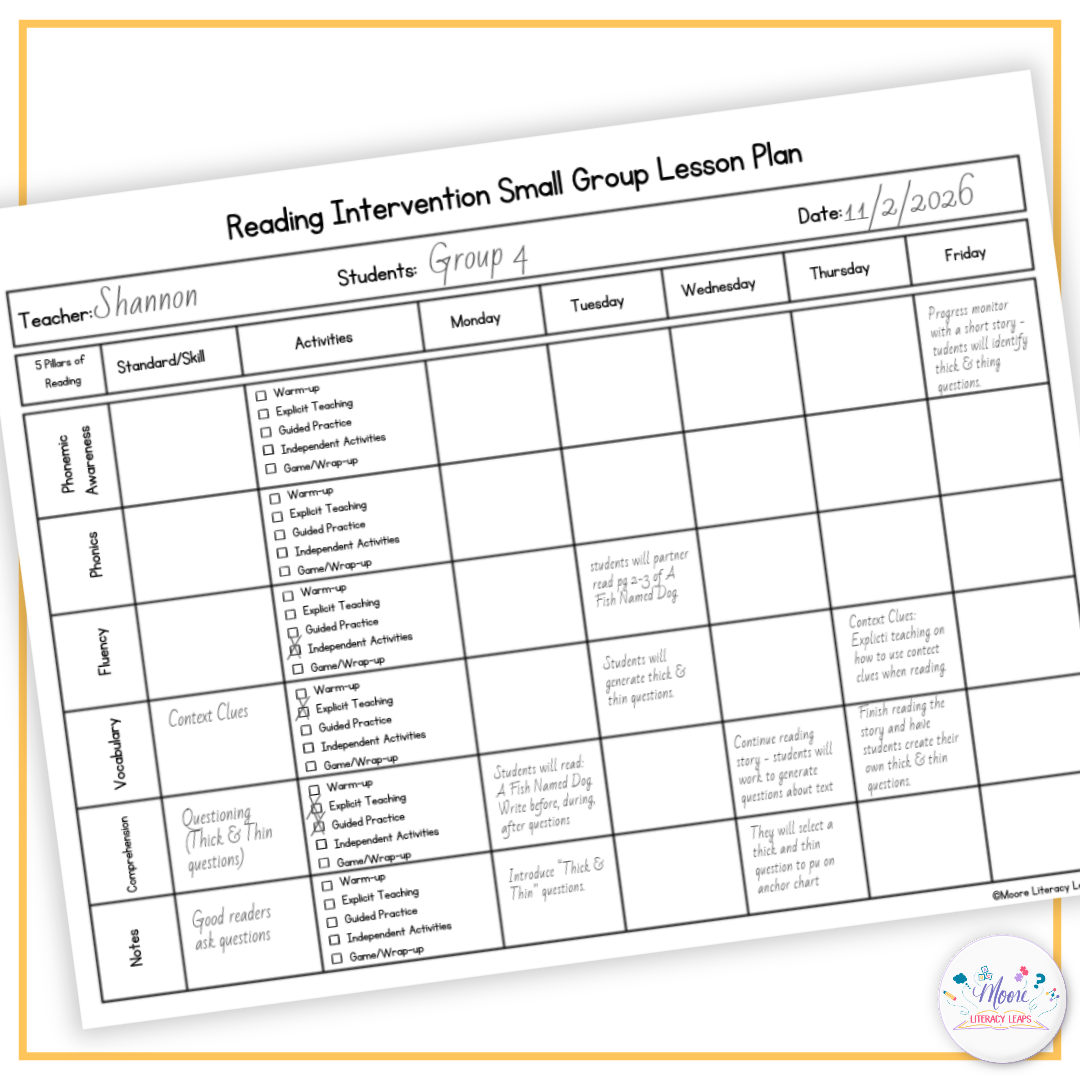
This is something that is often not thought about or skipped entirely during intervention lessons. Please make time for this. Reading and writing are synonymous (they go hand in hand), and we always want to make sure we are connecting the two.
Ex. Have students write 1–2 sentences with the short a CVC words. Make sure you give them the sentence. Have them count the number of words in the sentence and then write it. Be sure to check for punctuation and capitalization. Upper elementary students can write dictated sentences with the root word "tele."
Make Reading Intervention Planning Easier
Planning targeted reading intervention lessons gets faster once you follow the same 6 steps every day: warm up, teach, practice together, practice independently, read connected text, and write. Your students get consistent, explicit instruction, and you get back precious planning time.
Grab the Small Group Reading Intervention Lesson Plan Template
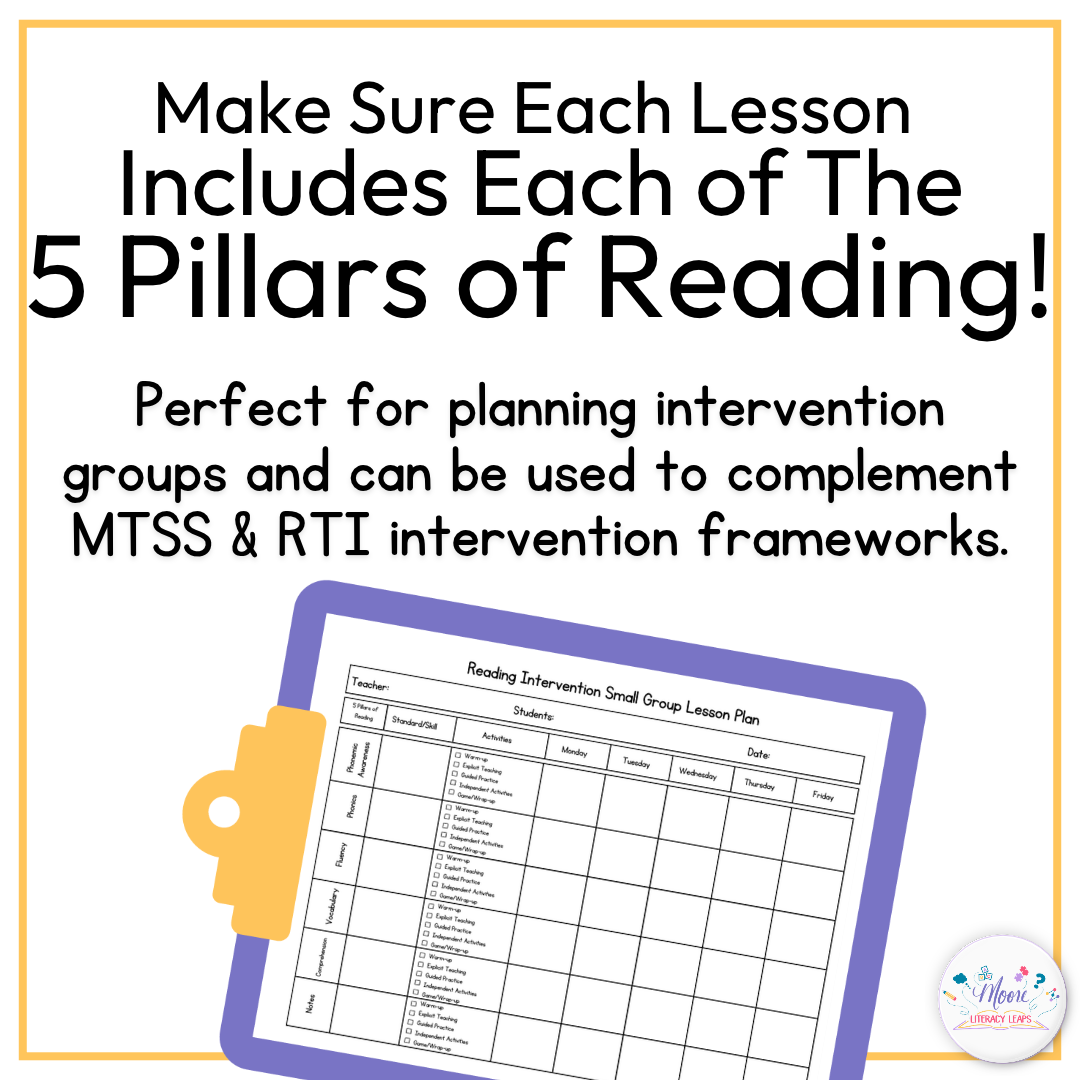
Want a done-for-you way to plan every small group lesson? My editable Reading Intervention & Small Group Lesson Planning Template builds the 5 Pillars of Reading (phonemic awareness, phonics, fluency, vocabulary, and comprehension) into every lesson.
Printable PDF for instant use
Editable versions in Canva and Google
Works with any RTI or MTSS framework
Teacher-friendly layout that keeps every group organized
Simplify your planning and spend more time on what matters most: helping your students grow into confident readers.
